Estimated reading time: 5 to 6 minutes
Key Engineering Takeaways
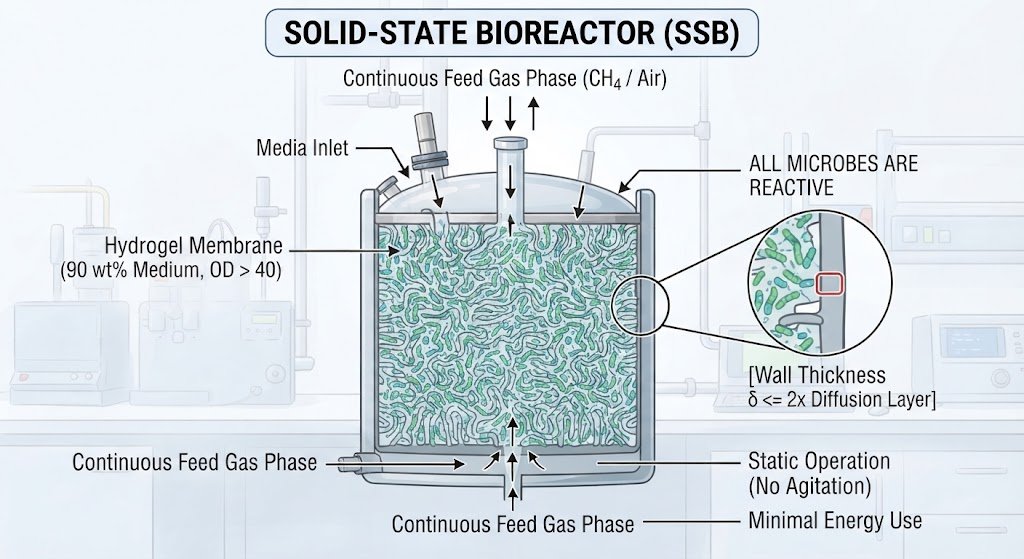
- Eliminates Agitation Energy: Static gas-phase operation avoids high mixing power (~1000 W/m³)
- 100% Reactive Volume: Thin walls (δ ≤ 250 µm) eliminate gas-starved passive zones
- High Density & Viability: 20 kDa PEGTA hydrogels enable OD > 40 with ~95% viability over 30+ days
- Predictable Pressure Scaling: Methane uptake scales linearly with pressure up to 2 atm per Henry’s Law
Simplified Product Recovery: Products leach directly into collection media without centrifuging cells.
Energy recovery from waste gas streams, such as agricultural biogas, landfill gas, and industrial off-gases is vital for sustainable manufacturing. Biocatalytic conversions using methanotrophs offer high specificity under mild conditions. However, industrial bioproduction relies on Stirred-Tank Reactors (STRs). STRs suffer from poor gas-to-liquid (GTL) mass transport for sparingly soluble gases like methane (CH₄), carbon monoxide (CO), hydrogen (H₂), and oxygen (O₂), yielding low volumetric productivities and requiring high agitation power (~1000 W/m³). To overcome this limit, researchers from Lawrence Livermore National Laboratory (LLNL), the National Laboratory of the Rockies (NREL), University of North Texas, and Quasar Energy Group developed a novel solid-state bioreactor (SSB) platform. Published in Scientific Reports, their study shows that immobilizing methanotrophs inside 3D-printed, gas-permeable hydrogel scaffolds enables static, gas-phase biocatalysis that boosts methane uptake by 1 to 2 orders of magnitude over traditional liquid-phase reactors.
The Root Problem: Reactive vs. Passive Cell Volumes
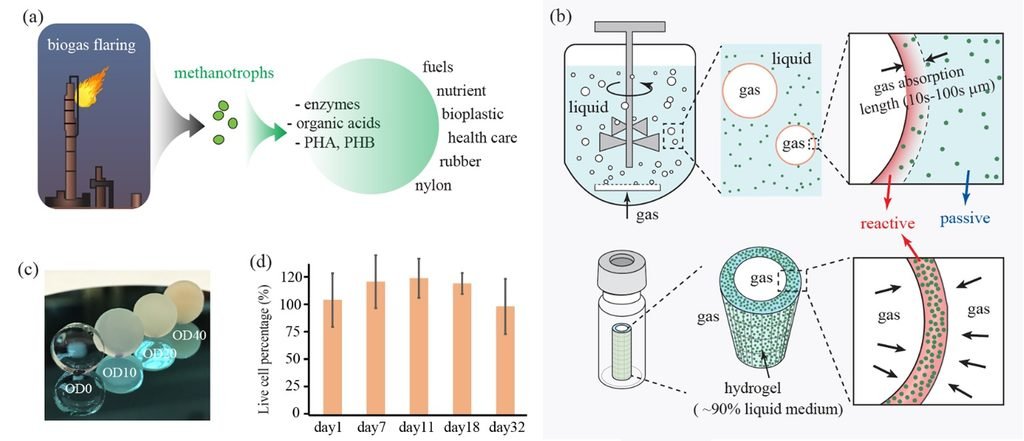
In standard STRs, biocatalysts are suspended in liquid medium while gas is sparged from the bottom. For poorly soluble gases, the diffusion boundary layer around bubbles spans only 10 to 100s of micrometers. Only cells within this narrow layer receive sufficient gas, operating in a reactive state. The remaining majority of cells in the bulk suspension are passive, starved of gas. For methanotrophs like wild-type Methylococcus capsulatus (Bath), this bottleneck limits optical density (OD) to ~4 and yields low volumetric productivity. Increasing agitation expands reactive area but escalates energy costs.
The SSB Solution: Hydrogel Immobilization & 3D Printing
The SSB replaces the bulk liquid phase with a continuous gas phase. Methanotrophs are encapsulated at high densities (OD > 40) inside a hydrogel containing ~90 wt% liquid medium. Gas diffuses into the gel from inner and outer walls. When hydrogel wall thickness (δ) matches the gas diffusion length, all embedded cells operate in the reactive state.
Biocompatibility Optimization
Initial encapsulation showed cell toxicity linked to low molecular weight monomers. Selecting a 20 kDa poly(ethylene glycol) tetra-acrylate (PEGTA) formulation (12 wt% PEGTA, 2.5 mg/mL LAP photo-initiator, cured under 405 nm light for 10 s) yielded ~95% cell viability post-curing and maintained viability for 32 days.
3D Printing Scaffold Architecture
To structuralize fragile hydrogels, rigid hollow cylindrical scaffolds (1 cm height, 3 mm inner diameter) were fabricated via projection microstereolithography using PR48 resin. The walls contained macroporous cubic void pores (~150 µm). Scaffolds were heat-cured at 190°C for 2 hours and treated with oxygen plasma for 5 minutes. Methanotrophs suspended in PEGTA prepolymer were pipetted into the macropores and photopolymerized in situ.
Performance Benchmarks & Results
Performance was evaluated using wild-type M. capsulatus (Bath) converting methane into succinate. Static mini-bioreactors (2 mL GC vials with 60 µL collection medium) were batch-fed with a 3:7 methane:air mixture at 1 atm.
1. Geometry-Dependent Methane Uptake
Decreasing scaffold wall thickness increased the reactive volume fraction, significantly boosting methane consumption:
| Reactor Configuration | Wall Thickness | 24-hr CH₄ Uptake Rate | Relative Performance |
| Liquid Control | N/A | 0.07 g/(L·h) | 1.0x (Baseline) |
| Hydrogel Disc | 2.0 mm solid | 0.22 g/(L·h) | 3.1x |
| Thick-Wall SSB | 1000 µm wall | 0.24 g/(L·h) | 3.4x |
| Medium-Wall SSB | 500 µm wall | 0.38 g/(L·h) | 5.4x |
| Ultra-Thin SSB | 250 µm wall | 0.93 g/(L·h) | 13.3x |
During shorter 6-hour incubation windows, the 250 µm SSB achieved a peak methane uptake rate of 2.1 g/(L·h)—1 to 2 orders of magnitude higher than reported methanotrophic STRs.
2. Succinate Yield & Stability
Daily succinate productivity reached 60 mg/(L·day) in the 250 µm SSB, representing a 4-fold increase over an STR with the same wild-type strain. Soluble succinate leached directly into collection medium, eliminating cell separation steps. Batch-fed SSBs maintained active methane uptake over 47 days.
3. Pressurized Operation (Henry’s Law)
Elevating headspace pressure in 250 µm SSBs yielded a linear increase in methane consumption: 0.58 g/(L·h) at 1.0 atm, 1.20 g/(L·h) at 1.5 atm, and 1.80 g/(L·h) at 2.0 atm. Liquid controls reached only 0.10 g/(L·h) at 1 atm.
Transport Physics: Governing Parameters
Gas transport in STRs is limited by the liquid convective mass transfer coefficient (kLa) across bubble boundary layers. In SSBs, transport is governed by hindered diffusion in the hydrogel (Deff ≈ 0.73 relative to water). The governing parameter defining SSB mass transfer is the Surface Area-to-Volume (SA/V) ratio, where SA/V = 2/δ for a thin cylinder wall.
Numerical modeling shows that a 500 µm SSB achieves 3 to 4 times higher volumetric methane consumption than an STR with moderate mass transfer (kLa = 0.02 s⁻¹) at equal cell density. Accounting for 10-fold cell densification (OD > 40 vs. OD ~ 4), volumetric productivity gains can reach 10-fold or higher.
Scale-Up & Process Integration
- Current Scale: Experiments were performed in static 2 mL GC vials.
- Industrial Scale-Up: To reduce 10–100 L STR volumes to several liters, the authors propose assembling SSB units in packed-bed flow reactors or extending hollow cylindrical scaffolds into hollow fiber membrane reactor modules.
- Broader Scope: This static gas-phase hydrogel concept applies directly to other gases (CO, CO₂, H₂) and oxygen-limited sugar fermentations.
References:
Ruelas, S., Gemeda, H.B., Ellebracht, N.C. et al. Solid-state bioreactors for efficient energy recovery from gaseous waste streams. Sci Rep (2026). https://doi.org/10.1038/s41598-026-54237-1