Estimated reading time: 8 minutes
The global food manufacturing sector stands at a critical juncture. Facing population growth, resource scarcity, and shifting consumer preferences toward sustainable, functional, and alt-protein products, food producers are under immense pressure to increase yield, eliminate batch failures, and maintain strict quality control. While conventional food processing relies heavily on physical and chemical operations, bio-enabled processing—such as fermentation, enzymatic conversion, and cellular agriculture—relies on living organisms and biological catalysts.
However, scaling biological systems is notoriously difficult. Biological variability, dynamic metabolic shifts, oxygen transfer limitations, and contamination risks introduce high levels of process instability. While the biopharmaceutical industry has aggressively adopted Bioprocessing 4.0 frameworks to overcome similar hurdles, the food industry has lagged behind. Food bioprocesses present unique engineering constraints, including highly complex and variable raw materials, mixed microbial cultures, low profit margins, and distinct food safety protocols.
To bridge this gap, a comprehensive framework introduced in Food Bioscience (Hassoun, Parra-López, and Carmona-Torres, 2026) formalizes Food Bioprocess 4.0. This paradigm represents the convergence of biological engineering, physical sensing and automation, and digital intelligence to convert empirical fermentation into a predictable, adaptive, and automated engineering discipline.
The Architectural Foundation: Three Interconnected Pillars
Unlike broad Industry 4.0 initiatives that focus generally on supply chain digitization, Food Bioprocess 4.0 specifically targets biomanufacturing unit operations. It operates through three core technological pillars that converge around the smart bioreactor.
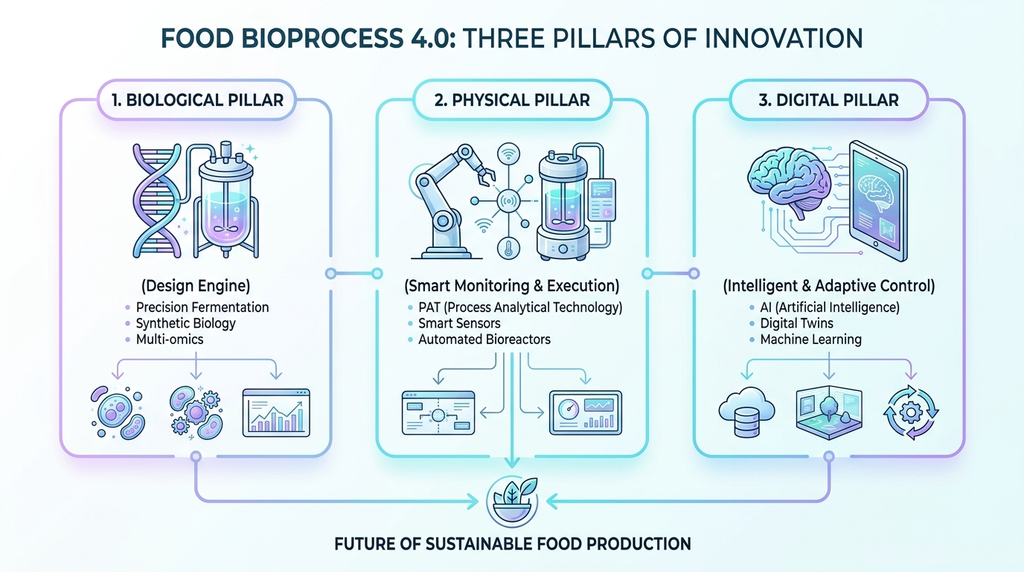
1. The Biological Pillar: The Design Engine
The biological pillar defines the biological performance, yield potential, and metabolic robustness of the cell factory. Rather than relying on empirical strain selection, Food Bioprocess 4.0 utilizes precision fermentation, synthetic biology, and targeted gene editing tools such as CRISPR to engineer microbial hosts (E. coli, S. cerevisiae, Komagataella phaffii, Lactococcus lactis).
These engineered hosts produce bioidentical functional proteins (e.g., recombinant caseins, β-lactoglobulin, lactoferrin, ovalbumin, collagen, hemoproteins), high-value enzymes, bio-preservatives, and sweet-tasting proteins like brazzein and monellin. Furthermore, the integration of multi-omics datasets (genomics, transcriptomics, proteomics, metabolomics) allows process engineers to uncover metabolic bottlenecks and stress responses that remain invisible to traditional physical probes.
2. The Physical Pillar: Smart Monitoring & Execution Infrastructure
The physical pillar creates a continuously observable cyber-physical environment. It replaces manual sampling and static setpoints with Process Analytical Technology (PAT), advanced non-destructive sensors, and Industrial Internet of Things (IIoT) connectivity.
Critical process variables (CPVs) and critical quality attributes (CQAs) are tracked in real time using:
- Vibrational Spectroscopy: Near-infrared (NIR), mid-infrared (MIR), Raman, and dry-film Fourier-transform infrared (FTIR) spectroscopy for rapid chemical fingerprinting of substrates, sugar profiles, and metabolite accumulation.
- Optical & Dielectric Sensors: In-situ optical fiber probes and dielectric capacitance sensors for real-time online biomass estimation, cell viability, and pH/dissolved oxygen (DO) tracking.
- Off-Gas Analysis: Mass spectrometry or electrochemical monitoring of CO₂ evolution rates (CER) and oxygen uptake rates (OUR) to evaluate metabolic respiration kinetics.
3. The Digital Pillar: Intelligent & Adaptive Control
The digital pillar provides the computational engine required to interpret massive, high-frequency multivariate data streams generated by the physical layer. Through artificial intelligence (AI), machine learning (ML), and digital twins, complex biological interactions are transformed into predictive control actions.
A major application in this layer is the deployment of soft sensors. Soft sensors use algorithms (such as Long Short-Term Memory [LSTM] neural networks or partial least squares [PLS] regression) to estimate hidden or hard-to-measure biological variables—such as intracellular enzyme concentration or metabolic fluxes—from accessible real-time physical signals (e.g., pH, DO, off-gas profiles).
The Closed-Loop Smart Bioreactor
The defining functional breakthrough of Food Bioprocess 4.0 is the establishment of a closed-loop feedback cycle. In traditional biomanufacturing, process adjustments are reactive, relying on offline laboratory testing and manual operator intervention. In contrast, the smart bioreactor operates as a self-correcting node within a cyber-physical ecosystem.
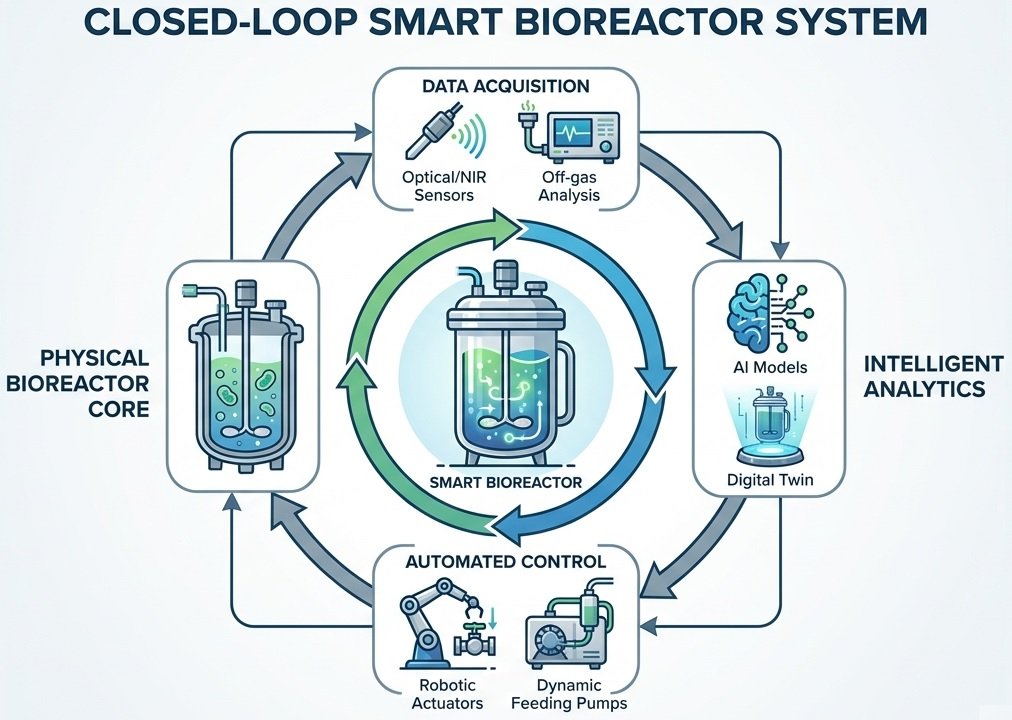
In this architecture:
- Data Acquisition: Smart sensors and PAT instruments continuously collect physical, chemical, and biological signals during fermentation.
- Intelligent Analytics: Data streams flow into cloud or edge computing platforms where AI models and digital twins process the signals. Digital twins integrate first-principles mechanistic mass/energy balances with data-driven ML models (hybrid modeling) or physics-informed AI to simulate current biological states and forecast process trajectories up to several hours in advance.
- Automated Control: When predictive models detect an incipient deviation (such as glucose exhaustion, oxygen transfer limitation, or early contamination), automated control systems dynamically adjust nutrient feed rates, agitation speed, aeration gas mixes, or temperature setpoints without human delay.
Upstream and Downstream Automation: From Self-Driving Labs to Smart Operations
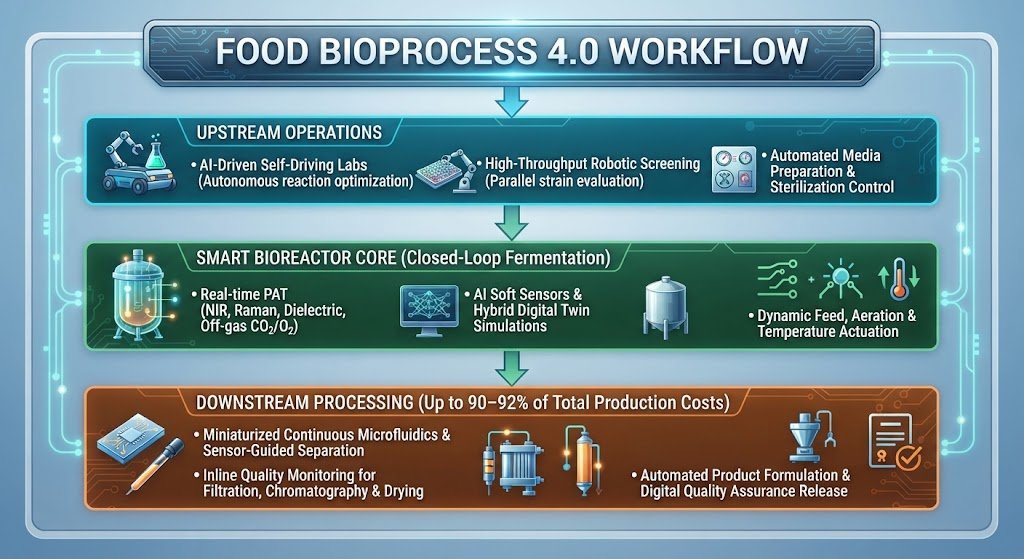
Automation in Food Bioprocess 4.0 extends across the entire unit operation sequence, connecting upstream media preparation with downstream separation and purification.
Upstream Innovations
- Self-Driving Laboratories: AI-guided robotic platforms autonomously plan and execute experiments across multi-parameter spaces. In enzymatic biocatalysis trials, an autonomous platform boosted enzyme activity from 2.22 to 11.80 kat/kg in just 11 autonomous design-build-test-learn (DBTL) cycles.
- High-Throughput Robotic Screening: Robotic assay systems for antimicrobial peptide (bacteriocin) production in L. lactis handled 48 parallel samples simultaneously, cutting assay processing times per plate from 120 minutes down to 40 minutes.
Downstream Innovations
Downstream processing (cell harvesting, filtration, membrane separation, chromatography, drying) can represent up to 90–92% of total manufacturing costs in bio-based production. Food Bioprocess 4.0 introduces inline PAT and automated sensor-guided feedback to continuous downstream equipment, such as miniaturized microfluidic separation modules, drastically reducing yield loss, solvent consumption, and batch variability.
Paradigm Shift: Traditional Bioprocessing vs. Food Bioprocess 4.0
The key operational transformations brought by Food Bioprocess 4.0 are summarized below.
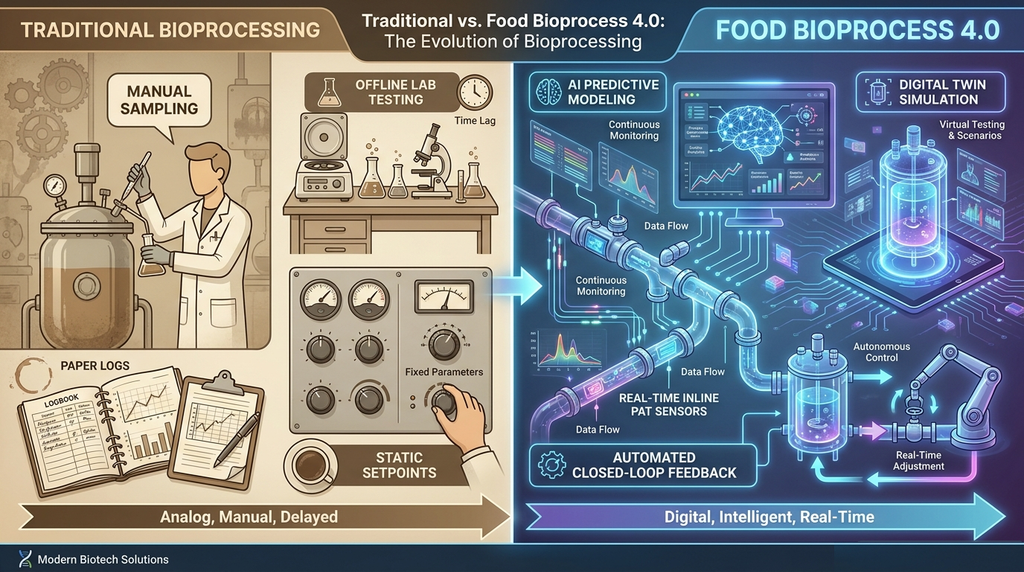
| Operational Aspect | Traditional Food Bioprocessing | Food Bioprocess 4.0 Paradigm |
| Process Monitoring | Periodic offline sampling; basic physical probes (pH, Temp, DO). | Continuous inline/online real-time monitoring via PAT (Raman, NIR) & smart sensors. |
| Process Control | Static setpoints; manual operator interventions; reactive troubleshooting. | Dynamic, automated closed-loop control; AI predictive adjustments. |
| Data Management | Unconnected univariate data; paper logs or isolated digital spreadsheets. | Integrated multivariate IIoT data streams; cloud analytics and ML pipelines. |
| Scale-up Method | High-cost physical trial-and-error at pilot scale. | Virtual simulation and scenario testing via Digital Twins. |
| Quality & Safety | Retrospective end-product testing; high risk of full-batch rejection. | Continuous Process Verification (CPV); early anomaly/contamination detection. |
| Traceability | Paper-based or isolated logs; vulnerable to record gaps. | Immutable digital logs; secure cloud/blockchain batch histories. |
Quantitative Proof-of-Concept: Industrial Case Studies
The review reported literature applications to demonstrate quantifiable performance gains across diverse food and beverage bioprocesses:
- Yield Hyperproduction (Aspergillus niger α-Amylase): Integrating online Raman spectroscopy with machine learning closed-loop feedback maintained glucose concentration within precise stoichiometric limits, increasing α-amylase enzyme yield by 46% while shortening total fermentation time by 28 hours compared to manual feeding.
- Real-Time Fermentation Forecasting (Yogurt): An AI deep learning model deployed during yogurt fermentation predicted pH trajectories with near-perfect accuracy (R² = 0.999 and RMSE = 0.079), enabling automated cooling interventions that prevented over-acidification and batch rejection.
- Kombucha Digital Twin: A digital twin coupling physical process data with predictive state estimators controlled carbon source consumption with RMSEP of 0.5538 mg/mL and bacterial cell concentration of 0.0558 mg/ml, stabilizing product taste profiles.
- Wine Fermentation Optimization: A hybrid machine learning-mechanistic model achieved 74% accuracy in yeast strain classification, while a deep learning surrogate model executed dynamic predictions 30-fold faster than traditional differential kinetic equations. Additionally, the IoT-enabled SmartBarrel system (combining electronic nose/tongue sensors with variable-length LSTM models) reduced prediction loss by over 45% without needing direct, invasive alcohol probes.
- Antibiotic / Secondary Metabolite Yields: Combining dual NIR and Raman spectroscopy for closed-loop dynamic feeding control boosted Gentamicin C1a production by 33% over traditional intermittent feeding.
Sustainability, Food Safety, and Digital Traceability Outcomes
Beyond process optics and yield improvements, Food Bioprocess 4.0 delivers measurable societal and environmental value:
1. Environmental Sustainability & Circular Bioeconomy
- Reduced Resource Waste: Real-time anomaly detection eliminates late-stage fermentation crashes, saving thousands of liters of nutrient media, process water, and cooling energy per batch.
- Decarbonization of Protein: Precision-fermented proteins can reduce greenhouse gas (GHG) emissions by up to 90% compared to conventional land-intensive livestock farming.
- Agro-Industrial Side-Stream Valorization: Smart bioprocessing facilitates the conversion of agricultural residues into second-generation bioethanol, organic acids, and microbial biomass within circular biorefineries.
2. Advanced Food Safety
Precision fermentation enables the clean-label production of bio-preservatives—such as the novel antimicrobial peptide SH biosynthesized in Lactococcus lactis, which exhibits selective, heat-stable activity against E. coli and Salmonella in fruit juices. Furthermore, enzymatic solutions like bio-produced asparaginase drastically reduce carcinogenic acrylamide formation in baked and fried foods.
3. End-to-End Digital Traceability
By linking PAT spectral logs, sensor timestamps, and batch parameters directly to cloud repositories or blockchain architectures, Food Bioprocess 4.0 creates immutable, tamper-evident digital batch records. This ensures complete auditability for novel foods, verifying feedstock sourcing and safety parameters for regulatory compliance and consumer confidence.
Key Technical Challenges and Horizon Toward Food Bioprocess 5.0
Despite its compelling benefits, full-scale industrial adoption faces several engineering and economic barriers:
- Sensor Fouling & Matrix Complexity: Food fermentation broths are viscous, opaque, highly heterogeneous, and prone to biofilm accumulation on optical probe windows. Frequent recalibration and signal drift remain persistent operational headaches.
- Data Heterogeneity & Model Uncertainty: Unlike biopharmaceuticals, food feedstocks suffer from seasonal and batch-to-batch compositional variability. ML models trained on narrow datasets often fail to generalize across facilities. Explainable AI (XAI) and confidence scoring are necessary to prevent catastrophic automated control decisions.
- High Capital Expenditure (CapEx): Retitting legacy plants with PAT instrumentation, automated control valves, and cloud analytics platforms requires substantial initial investment, presenting high payback hurdles for small- and medium-sized enterprises (SMEs).
- Interdisciplinary Workforce Gap: Successful implementation requires professionals skilled simultaneously in bioprocess engineering, microbiology, industrial automation, and data science—a combination currently rare in the food industry.
The Vision of Food Bioprocess 5.0
As the industry overcomes these integration hurdles, the framework will evolve toward Food Bioprocess 5.0. While 4.0 focuses on connectivity, automation, and digital twins, 5.0 will re-introduce human-centric design, cobotics (collaborative robotics), supply chain resilience, and “sustainability-by-design” to build a truly adaptable and human-aligned biomanufacturing ecosystem.
Strategic Summary for Biochemical & Process Engineers
Food Bioprocess 4.0 shifts food biomanufacturing from an art reliant on empirical trial-and-error into a data-driven, highly controllable engineering discipline.
To start implementing these concepts:
- Begin with Sensing: Upgrade critical unit operations with non-invasive PAT instruments (e.g., inline Raman or NIR spectroscopy) to build high-density baseline datasets.
- Leverage Hybrid Modeling: Combine basic kinetic equations with machine learning soft sensors to estimate unmeasured state variables before jumping into fully autonomous control.
- Focus on Closed Loops: Connect real-time analytics to dynamic feeding and aeration actuators to stabilize batch trajectories, reduce batch-to-batch variability, and secure immediate yield gains.
References:
Hassoun, A., Parra-López, C. & Carmona-Torres, C. Food bioprocess 4.0: Transformation of food bioprocessing through biological, physical and digital innovations. Food Biosci (2026). https://doi.org/10.1016/j.fbio.2026.109663